Be yourself; Everyone else is already taken.
— Oscar Wilde.
This is the first post on my new blog. I’m just getting this new blog going, so stay tuned for more. Subscribe below to get notified when I post new updates.
Be yourself; Everyone else is already taken.
— Oscar Wilde.
This is the first post on my new blog. I’m just getting this new blog going, so stay tuned for more. Subscribe below to get notified when I post new updates.
“Being a single mother is twice the work, twice the stress, and twice the tears, but also twice the hugs, twice the love, and twice the pride”, a quote that many single mothers can relate to. Being raised solely by my mother has come with many challenges but has also taught me many things. I was able to not only witness both the physical and emotional strains, but also the benefits as well. My mom has taught me some of life’s most valuable lessons. One of the most important lessons was to obtain an education and be able to financially provide for myself, which I believe is an important lesson for all women to live by. This leads into the topic I will be arguing of child social disadvantages associated with single parenting.

With the divorce rate being so high in today’s society, it is important to understand single parenting and all it encompasses. The US divorce rate in 2019, was about 40-50% of all marriages that ended in divorce, which is an alarming number to many people. Not only is this a concern for marriages, but also the children are affected by this as well.About 25% of individuals, just over the age of 18, have experienced a parent’s divorce. This is why it is important to understand the phycological and sociological effects that it has on children living under these circumstances.”Divorce often creates significant stress that can have an impact on parent-child relationship satisfaction”, as well as social disadvantages (Murphy/Martin, 13). The findings below depict lifestyles of both single fathers and single mothers. Although, according to Cohen “most, but not all, of these single parents are women, who lead 82 percent of poor single-parent households” (Cohen, 417).

According to Cohen, “the most important factor separating children of single mothers from those whose parents are married and living together is simply their lower incomes” (Cohen, 145). Regarding poverty, “mothers raising children alone are more likely to be low-income, African American, and less educated. Their children typically have lower test scores, are more likely to drop out of school, and have greater emotional and behavioral difficulties” (Morsey/Rothstein, 10). Children living with single mothers, may not experience the same lifestyle as those living with married parents. Some of these disadvantages may include, time spent with each parent, schooling preferences, extracurricular activities/ sports, and even behavioral effects. With children being restricted from associating and interacting with other children, it could leave them at a severe social disadvantage.
First, we will be looking at the aspect of time spent with each parent. One aspect that one must consider, is that typically both parents must work. Cohen mentions how, “single mothers have less time to spend with their children than do married parents” (Cohen, 146) This is because single parents must work to support their families. Another area to consider, is when parents are divorced, a child typically splits their time with each parent. According to Richard Warshak, “children who spend at least 35 percent time with each parent, rather than live with one and visit the other, have better relationships with their fathers and mothers and do better academically, socially, and psychologically” (Warshak, 1). Keeping that in mind, children who have no interaction with either father or mother are at a severe disadvantage. Children who face complete absence of either parent, are more likely to smoke, drink, do drugs, and even face anxiety, depression and stress related illnesses. This lack of time spent with each parent also inhibits a child’s abilities in school. In an academic article written by Amoto, it is shown that,“During a divorce, children are often left to their own devices in terms of school, community interactions, and emotional processing” leaving children falling behind in comparison with other students (Amato, 125) . It also states the reason for this, “These children often fall behind in school as their parents have less time to spend coaching them in schoolwork” (Sandler, 3). Cohen ties this all together by saying “the lack of parental time cuts down on supervision and support for children as they mature” (Cohen, 146).

Next, it is important to look into the effects from the lack of socialization with other kids. As mentioned earlier, this comes from extracurricular activities like sports, clubs, and school activities. Studies show that due to the lack of income and poverty levels of single parents, children often do not have the opportunity to take part in these types of activities. A recent article mentions how, “the financial changes that a family generally experiences during divorce can be deleterious to children’s social opportunities” (Amoto, 127) leaving these children at a social disadvantage in comparison to children living with married parents. In an academic article titled, Extracurricular Activity Involvement and Adolescent Self-Esteem, it is stated that “Research has demonstrated a connection between structured activity involvement and several indicators of positive youth development”, which shows how important this aspect is in child development (Kort-Butler, 13). Involvement in extracurricular activities and sports can help a child’s self esteem as well as their socialization skills. This same study mentions how, “adolescents whose families can afford the costs of participation are also more likely to enroll” (Kort-Butler 13,). Proving that children with parents who cannot afford these activities are less likely to enroll.
With these findings in mind it is important to consider the institutions and areas that are affected. Looking further into single parenting, along with the United States, two international countries with the highest percent of single parents are Denmark and the United Kingdom. In both of these countries, women head about 88% of these households. “The largest increases in single parent households have been in industrialized countries”, two of these, as previously mentioned, being Denmark and the United Kingdom. “Lone mothers make up a quarter of all families with children in the United Kingdom and have been one of the key target groups for activation policies for the past two decades “(Millar,1). According to an academic article titled, One-Parent Families in Denmark, one can see a deep analysis of single- parent families within the country. According to the article, “During the last 10 to 15 years there has been a rapid increase in the number of divorces, from about 6,000 to now 13,000 per year, and minor children are found in 60% of the divorce cases” (Koch-Nielsen, 20). The graph below depicts Denmark, and the United Kingdom with the highest numbers of single parents within households.
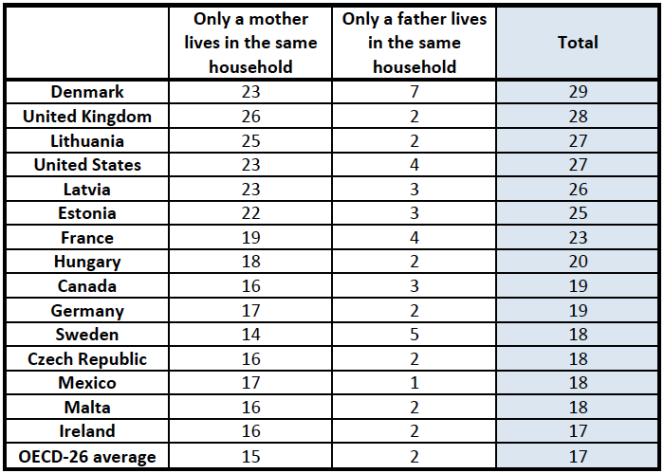
The reason why these countries face the highest numbers is because it is more socially acceptable and there is no stigma, similar to the United States. Stigma can be defined as “a mark of disgrace associated with a particular circumstance, quality, or person”. This term usually leaves people feeling self-conscious about their decisions, based on how others perceive them. “It’s easier to be a single mother in Denmark than elsewhere because society accepts and supports you – we’re pretty liberal about most things”, stated in a recent web article. Women would rather solely raise their children themselves rather than stay in a toxic relationship. In other countries, women would be condemned for this which is why Denmark and the United Kingdom see higher rates of single mothers. These single parents are socially supported and are free to make their own decisions.
In conclusion, it can be seen that a “marital status is associated with children’s social-emotional development in very early childhood” and “this association may have cumulative consequences for individual development in later life stages” (Huang, Kim, Sherraden, Clancy 244). Unfortunately, it can be seen that children raised by single parents may face sociological disadvantages compared to other children. While these disadvantages can have lifelong effects on a child’s well-being, a parents love is unconditional. Life may bring about unfortunate circumstances, but how an individual responds can make all the difference.
“The depth of the love of parents for their children cannot be measured. It is like no other relationship. It exceeds concern for life itself. The love of a parent for a child is continuous and transcends heartbreak and disappointment.”
– James E. Faust
Key words: Poverty, Stigma, Divorce, Parenting, Male, Female
Cohen, Phillip. The Family. W.W. Norton, 2015.
Morsy, Leila, and Richard Rothstein. “Five Social Disadvantages That Depress Student Performance: Why Schools Alone Can’t Close Achievement Gaps.” Economic Policy Institute
American Psychological Association, American Psychological Association, www.apa.org/topics/divorce/.
“Shocking Statistics About Children and Divorce – Free Background Checks.” FreeBackgroundChecks.com, 11 July 2019, freebackgroundchecks.com/learn/shocking-statistics-children-and-divorce/.
Warshak, Richard A. “Kids Who Spend Time with Each Parent after a Divorce Have Better Health and Development, Research Shows.” Business Insider, Business Insider, 26 May 2017
Amoto. Sandler. Ultius. “Children of Divorce: Sociological Study.” Ultius, www.ultius.com/ultius-blog/entry/children-of-divorce-sociological-study.html.
Scientist, The Spaced-Out. “Single Parents Worldwide: Statistics and Trends.” The Spaced-out Scientist, 11 Nov. 2017, spacedoutscientist.com/2017/07/18/single-parents-worldwide-statistics-and-trends/.
Millar, Jane. “Self-Responsibility and Activation for Lone Mothers in the United Kingdom.” American Behavioral Scientist, vol. 63, no. 1, Dec. 2018, pp. 85–99., doi:10.1177/0002764218816804.
Amato, P. R. (2005). The impact of family formation change on the cognitive, social, and emotional well-being of the next generation. Future of Children, 15(2), 75–96. doi:10.1353/ foc.2005.0012.
Huang, Jin, et al. “Unmarried Mothers and Children’s Social-Emotional Development: The Role of Child Development Accounts.” Journal of Child and Family Studies, vol. 26, no. 1, 2016, pp. 234–247., doi:10.1007/s10826-016-0551-1.
Kort-Butler, Lisa A. “Extracurricular Activity Involvement and Adolescent Self-Esteem.” PsycEXTRA Dataset, 2012, doi:10.1037/e535002013-004.
Koch-Nielsen, Inger. “One-Parent Families in Denmark.” Journal of Comparative Family Studies, vol. 11, no. 1
Murphy, Kelly L., et al. “Parental Stress and Parent-Child Relationships in Recently Divorced, Custodial Mothers.” European Journal of Educational Sciences, vol. 05, no. 02, 2018, doi:10.19044/ejes.v5no2a1.

My name is Katie Ludwicki and I am currently a second semester senior. I am originally from Northvale, New Jersey which is about 25 minutes outside of New York City. I am majoring in accounting and plan to earn my Masters degree next year. After graduating, I am excited to begin a career at PricewaterhouseCoopers in downtown Albany, where I will be working in their tax department. I am amongst the other 69.7% of Americans who attend a college or university after graduating from high school. I am so thankful for the education and opportunities that Siena has offered to me and could not have imagined myself attending any other college or university.
My favorite hobby is swimming. I have been a competitive swimmer for 16 years and have continued my swim career here at Siena College for all four years. Only 7% of all high school athletes continue on to play for a division 1 college or university, which is why swimming in college was a lifetime goal of mine.

I have one older sister, Kristin, who is 23 years old. She also attended Siena and graduated last year with a bachelor’s degree in physics. She currently attends RPI and is earning a second bachelor’s degree in biomedical engineering. After graduating she is planning on continuing her education and obtaining a PhD. My sister and I are very close and share many of the same hobbies and interests, one being swimming. She is definitely my best friend and someone I look up to.

My sister and I come from a “broken home”, as stated in today’s society. My parents got divorced when I was around seven years old and I lived with my mom until leaving for college. My mom, sister and I all have a very close relationship and have grown together as a family. We are Christians and usually attend church every Sunday together as a family. Our faith has impacted our lives significantly and has guided us through some of life’s hardest moments.
Single mother households have grown so common in America that today 80 percent of single-parent families are headed by single mothers.

Although my sister and I grew up living with my mom, we both are still very close with my dad. We get dinners, go on vacations, and spend holidays together which have expanded our relationship in many ways. Even though we did not spend everyday together, our relationship did not change and still managed to grow as the years went on.

Around 25% of people over the age of 18 have gone through a parents divorce, which is a rising number in today’s society. Although divorces in households are becoming more and more common, children still suffer the consequences and the effects that come along with them.
My family does not execute the “breadwinner-homemaker family”, which means you have an employed father, and an unemployed mother (Cohen, 17). Being that my parents got divorced while my sister and I were still young, both of my parents had full time jobs. They both had significant power in the workforce, and worked very hard to provide comfortable lives for my sister and I. We both had the privilege of attending college and working towards our future goals because of the support of our parents. Only around 33% of children with divorced parents have the privilege of attending a college or university, which is why I am very grateful for all the sacrifices my parents made for my family.
This is an important concept in social class position because some people who may not be as privileged do not have the opportunity to attend a college or university due to financial implications. I would classify my direct family as being part of the middle class, which 42.4% of Americans are within the middle class range (Cohen, 129). I have definitely considered myself lucky for being able to live the life that I can currently live.
I am thankful for the family that I have been blessed with and although I was faced with some challenging situations, I believe it shaped me into the person I am today.
http://www.scholarshipstats.com/varsityodds.html
https://singlemotherguide.com/single-motherstatistics/
https://www.businessinsider.com/middle-class-income-us-city-san-francisco-2018-2
Cohen, Philip N. The Family: Diversity, Inequality, and Social Change. W.W. Norton & Company, Inc., 2018.
This is an example post, originally published as part of Blogging University. Enroll in one of our ten programs, and start your blog right.
You’re going to publish a post today. Don’t worry about how your blog looks. Don’t worry if you haven’t given it a name yet, or you’re feeling overwhelmed. Just click the “New Post” button, and tell us why you’re here.
Why do this?
The post can be short or long, a personal intro to your life or a bloggy mission statement, a manifesto for the future or a simple outline of your the types of things you hope to publish.
To help you get started, here are a few questions:
You’re not locked into any of this; one of the wonderful things about blogs is how they constantly evolve as we learn, grow, and interact with one another — but it’s good to know where and why you started, and articulating your goals may just give you a few other post ideas.
Can’t think how to get started? Just write the first thing that pops into your head. Anne Lamott, author of a book on writing we love, says that you need to give yourself permission to write a “crappy first draft”. Anne makes a great point — just start writing, and worry about editing it later.
When you’re ready to publish, give your post three to five tags that describe your blog’s focus — writing, photography, fiction, parenting, food, cars, movies, sports, whatever. These tags will help others who care about your topics find you in the Reader. Make sure one of the tags is “zerotohero,” so other new bloggers can find you, too.

 Sociology